The "is BitMEX legit" question has a fairly direct answer. The platform has operated continuously for over a decade under the same legal entity, has not lost client funds in any custody breach, and publishes Proof of Reserves at a cadence ahead of the rest of the field with an open-source verifier.
Risk Notice. Trading cryptocurrency and crypto-settled instruments carries a substantial risk of capital loss. Leverage amplifies both gains and losses, and on derivatives a position can be liquidated in full before any manual exit is possible. Availability of products and account features depends on the local rules of the user's jurisdiction. Nothing in this guide is financial advice; readers should make their own assessment before opening or funding an account.
The is bitmex legit query keeps surfacing in 2026 for a reason. BitMEX has been around long enough for old controversies to age into folklore, it sits in a category where the bar for trust is naturally higher than for a spot-only retail exchange, and the kind of user typing that phrase usually wants more than a yes-or-no answer. This review walks through what actually moves that question: who runs the platform, how client funds are held, how solvency is proved, what verification looks like, what spot trading costs, and how the venue compares against the rest of the field.
§ 01Track Record Who Runs BitMEX and What's the Record?
BitMEX launched in 2014. That is several years before "perpetual swap" became standard crypto vocabulary; the format itself was introduced on this venue in 2016 and has since been copied by every major derivatives exchange that followed. The operating entity is HDR Global Trading Limited, registered in Seychelles, founded by Arthur Hayes, Ben Delo and Samuel Reed. The legal structure has not shifted materially in more than a decade.
The single cleanest signal for an is BitMEX legit check is the operating record. Eleven years of continuous operation, zero successful breaches of customer custody. That is uncommon at any size of book and unusual in a category that runs at this leverage profile. Whether a cryptocurrency exchange can hold client assets through full market cycles without a security failure is one of those things only time can demonstrate.
Eleven years of continuous operation, zero successful breaches of customer custody — uncommon at this size, unusual at this leverage profile. — Editorial Desk · Trust & Safety Review
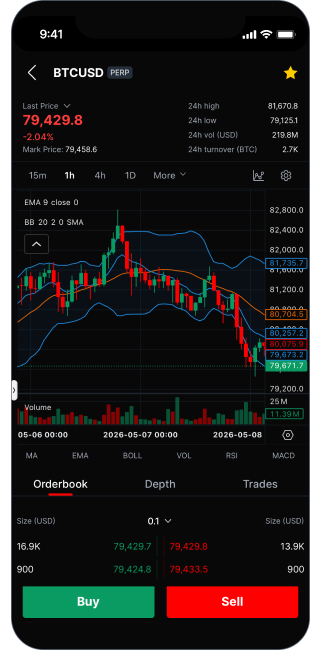
§ 02Fund Safety How Safe Are Client Funds on BitMEX?
The architecture has three components worth understanding separately, because a "safe to use" answer rests on each.
Custody
BitMEX uses MPC custody (multi-party computation) for key management. The private key is never assembled in one location. Signing happens through distributed shares held by separate parties, so no single device or operator ever has the full key material. This removes the most common single-point-of-failure scenario in crypto exchange custody. Storage of client assets is 100% cold, with no hot-wallet exposure designed into the architecture.
Account-side controls
The platform supports 2FA, withdrawal address whitelists, IP restrictions on API keys and PGP-encrypted email notifications. Customer balances are held segregated and are not lent out to other users. Small withdrawals process through an automated flow; larger or risk-flagged ones route to manual review.
Insurance Fund
The pool that absorbs losses from positions liquidated below bankruptcy price is published live at bitmex.com/app/porl. Because the value moves daily, any fixed figure cited in older bitmex coverage is not a useful reference point.
The architecture answers the two questions that matter most in a "is the venue safe" check: where the keys sit (distributed, never reconstructed) and where the coins sit (entirely in cold storage). Neither is verifiable directly by a user, but both are publicly stated and both are consistent with the eleven-year operating record.
§ 03Proof of Solvency How Does BitMEX Prove Solvency?
A custody story without independent proof is hard to assess. The Proof of Reserves cadence is one of the cleanest places where BitMEX diverges from the rest of the cryptocurrency exchange field.
The platform publishes Proof of Reserves and Proof of Liabilities twice per week at bitmex.com/app/porl. The Reserves side uses signed messages from on-chain addresses to demonstrate control over the underlying BTC. The Liabilities side uses a Merkle Sum tree, a modified Maxwell scheme: each leaf carries a plaintext balance plus an HMAC256 commitment with a per-user nonce, and the root commits to the sum of all liabilities.
What this means in practice:
- Every user receives their own nonce and can verify that their balance is included in the published tree without revealing anyone else's position.
- The verifier code is open source at github.com/BitMEX/proof-of-reserves-liabilities. A technically inclined reader can run the verification independently rather than trusting an internal claim.
- Twice weekly is meaningfully more frequent than the monthly publication standard at competitor venues, giving a much shorter window for any divergence between liabilities and reserves.
A Proof of Reserves snapshot alone does not prove solvency. "We control these BTC addresses" tells nothing useful unless paired with "and these are the obligations against them." The Merkle Sum tree binds the two sides cryptographically, so the published proof is a proof of solvency rather than a proof of having some coins somewhere.
§ 04Verification What Does Verification Look Like in 2026?
Registration takes a few minutes. The entry points are email and password, a Google sign-in, or an Apple sign-in. Identity verification is mandatory before any trading activity and runs through four steps.
- A government-issued photo identification. Passport, national ID card, or driving licence.
- A selfie with a liveness check. A short video or camera capture from the device used for verification, used to match against the submitted ID.
- Confirmation of physical location. The system uses one of three methods. Browser geolocation clears most users automatically. A government database lookup is the second route. A proof of address document such as a utility bill or bank statement is the fallback.
- A short questionnaire covering trading experience, source of funds and the purpose of the account.
Most individual applications clear within hours. After approval, the account is funded by crypto deposit. There is no native fiat rail on the venue itself, so the standard route is to buy stablecoins or BTC on a local onramp and transfer them in. Multi Asset Margining lets USDT, USDC, ETH or XBT all sit on the same balance, which removes a step many platforms still require.
For the reader who arrived from a 2020-era review: BitMEX is not a no-KYC venue any more, and any source claiming otherwise is dated.
§ 05Spot Trading Cost What Does Spot Trading Cost?
Fees are where third-party coverage most often drifts from the current schedule, so this section sticks closely to the live ladder. The structure is an 8-tier ladder shared by spot and derivatives, with tier placement determined by the higher of two conditions: BMEX tokens staked or 30-day trading volume in USD. A user who has staked enough BMEX to qualify for VIP 1 sits on VIP 1 even with no trading volume in the month; staking is one of two ways to reach a tier, not a multiplier layered on top.
| Tier | BMEX Staked | 30D Volume (USD) | Spot Maker | Spot Taker |
|---|---|---|---|---|
| Regular 1 | ≥ 0 | ≥ 0 | 0.0500% | 0.0500% |
| Regular 2 | ≥ 1,000 | ≥ 1,000,000 | 0.0500% | 0.0500% |
| Regular 3 | ≥ 10,000 | ≥ 2,500,000 | 0.0500% | 0.0500% |
| VIP 1 | ≥ 50,000 | ≥ 10,000,000 | −0.0025% | 0.0500% |
| VIP 2 | ≥ 150,000 | ≥ 25,000,000 | −0.0050% | 0.0500% |
| VIP 3 | ≥ 300,000 | ≥ 50,000,000 | −0.0075% | 0.0500% |
| VIP 4 | ≥ 750,000 | ≥ 100,000,000 | −0.0100% | 0.0500% |
| VIP 5 | ≥ 2,000,000 | ≥ 250,000,000 | −0.0150% | 0.0500% |
A fresh account starts at 0.0500% on both sides of spot. Maker rebates begin at VIP 1 and are not available on Regular tiers. Maximum discount versus the base Regular 1 rate is up to 75% at the top of the VIP ladder. BMEX staking also pays an APY in the range of 5 to 7.5% depending on tier, with current numbers on bitmex.com/bmex. The full live fee grid sits at bitmex.com/app/fees.
For a typical retail spot ticket, the cost is 0.05% on each side, and there is no centrally-quoted spread layered on top of the public order book the way some retail platforms apply a markup. Order book pricing is set by other participants, not by the venue.
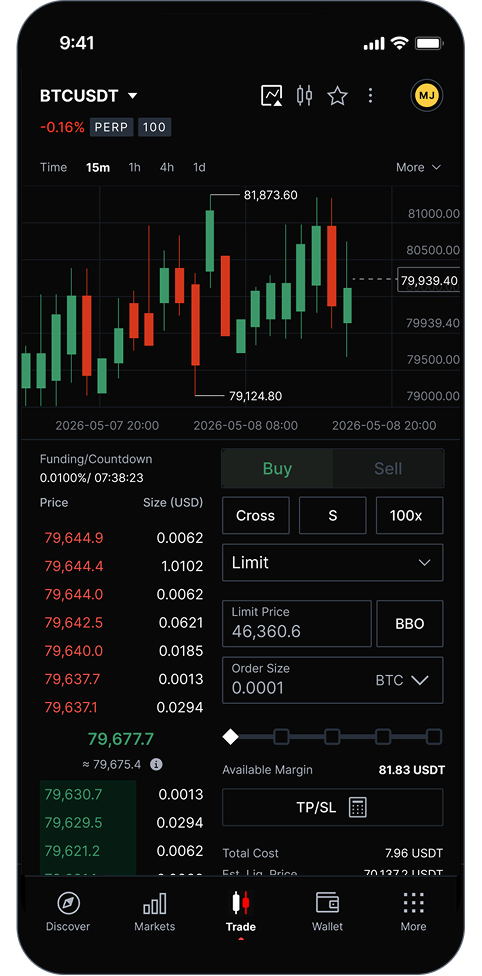
§ 06Product Surface What Else Is on the Platform?
The product mix is broader in 2026 than the legacy "perpetual swaps only" reputation suggests, worth knowing even if day-to-day use is going to be spot.
| Product | Detail |
|---|---|
| Spot | Direct buying and selling of supported coins, no leverage |
| Crypto Perpetual Swaps | XBTUSD up to 100×, ETHUSD up to 200×, plus 100+ altcoin pairs at up to 100× |
| Fixed-Expiry Futures | Quarterly and monthly contracts on the major pairs |
| TradFi Perps — Stocks (20×) | AAPL, TSLA, MSFT, NVDA, META, AMZN, GOOGL, COIN, HOOD, PLTR, MSTR, ORCL, plus SPY and QQQ wrappers |
| TradFi Perps — Commodities (25×) | Gold, Silver, WTI, Brent |
| TradFi Perps — FX (up to 100×) | EUR/USD, USD/JPY, GBP/USD, AUD/USD, USD/CHF, USD/CAD |
| Copy Trading (Guilds) | Native copy-trading product with Hyperliquid leaderboard integration |
| Reverse Copy Trading | Take the opposite side of strategies the platform's metrics flag as consistent losers |
| Trading Bots | Built-in grid bots, no API setup required |
| Multi Asset Margining | USDT, USDC, ETH and XBT all back positions on the same account |
| Hedge Mode | Long and short on the same instrument at the same time |
| BMEX Token + Staking | Fee discounts up to 75%; current numbers on bitmex.com/bmex |
The TradFi FX line is worth pulling out specifically. Major FX pairs trade around the clock, including weekends, and there is no overnight swap fee built into the contract — that is structurally different from holding the same exposure via a spread-bet or CFD product where overnight financing accrues. For a reader used to running an FX view through a traditional broker and watching the swap line eat into the position over a long hold, the equivalent BitMEX position has a different cost shape.
Reverse Copy Trading is the other genuinely uncommon piece. The standard copy product mirrors a chosen trader; the reverse variant systematically takes the opposite side of a strategy the venue's metrics flag as a consistent loser. The mechanism itself is not available on the major competitor venues.